You’ve probably heard people rave about padel. You’ve almost certainly seen pickleball courts popping up.
They’re two of the fastest growing racket sports in the UK right now, and if you’re trying to pick one to try first, the choice isn’t as obvious as it looks.
Both sports are designed to be picked up in a single session. Both use a paddle or racket rather than a stringed frame, both are played as doubles far more often than singles, and both have borrowed ideas from tennis and squash to build something easier to enjoy from the first rally.
The differences matter, though, and knowing them in advance will save you from booking the wrong court for what you actually want out of a Saturday afternoon.
We’re Glasgow’s first club built around both padel and pickleball, so we spend every week watching people work out which sport they prefer.
Here are some of the key differences between padel and pickleball to help you decide which suits you best.
Padel vs pickleball at a glance
In short, padel is played on an enclosed court surrounded by glass and mesh, using a solid perforated racket and a slightly depressurised tennis ball.
Pickleball is played on an open court that’s similar in size to a doubles badminton court, using a solid paddle and a perforated plastic ball, at a slower pace and with its own quirky rules.
The difference is that padel is physical, loud, and tennis-like. Pickleball is slower, gentler, and easier to pick up cold.
Both are faster to learn than tennis or squash, and both are more social than most racket sports.
So the question of pickleball vs padel usually comes down to what you want out of an evening’s play.
Similarities between pickleball and padel
Before digging into the differences, it’s worth naming the similarities between pickleball and padel.
Both sports are doubles-first. Both use a solid bat instead of a strung racket. Both are similar to tennis in their basic shape (serve, rally, scoring, swap sides). And both borrow from tennis and squash for their shot vocabulary.
Drop shots, lobs, and volleys all feature in both games.
A tennis player or squash player transferring across will find the underlying logic familiar, with a shorter learning curve than in tennis.
The other similarity is the social culture around each sport.
Neither game is built for solo practice.
Both reward chat between points, both draw mixed groups of friends, and both have built their UK growth on social play rather than elite competition.
The differences and similarities between pickleball and padel both shape the decision you make next.
Key difference between padel court vs pickleball court
The court is the most obvious difference between padel and pickleball, and it tells you a lot about how each sport actually plays.
A padel court measures 20 metres by 10 metres.
Padel is played on an enclosed court surrounded by glass walls at the back and sides, with wire mesh stretching higher above.
The court is surrounded by glass specifically so the ball can rebound off the back and side walls during a rally, which turns every point into a three-dimensional puzzle. It is slightly smaller than a tennis court but noticeably larger than a pickleball court, so you cover ground around the court without ever feeling cramped.
A pickleball court measures 13.4 metres by 6.1 metres, which is exactly the same dimensions as a doubles badminton court.
The pickleball court is played on an open court with no walls and a low net that sits 36 inches at the posts.
The game is played on a court that includes a distinctive seven-foot non-volley zone on either side of the net, known as the ‘kitchen’, where you can’t volley. The court is small, the ball moves slowly, and a good rally rewards soft touch over big swings.
The short version.
Padel is designed for longer, more physical rallies with walls in play. Pickleball is played on a smaller court and the slower ball designed for precision and patience.
The padel racket, pickleball paddle, and the balls
Both sports use a solid bat rather than a strung racket, but the tools are different.
Padel racket
A padel racket is a solid, teardrop-shaped bat made of carbon fibre reinforced polymer and fibreglass with a foam core.
The face is perforated with a pattern of holes to cut wind resistance and make the swing feel lighter.
A padel racket typically weighs between 340 and 390 grams, and the textured face lets you put spin on the ball.
It feels more like a tennis racket than a table tennis paddle.

Pickleball paddle
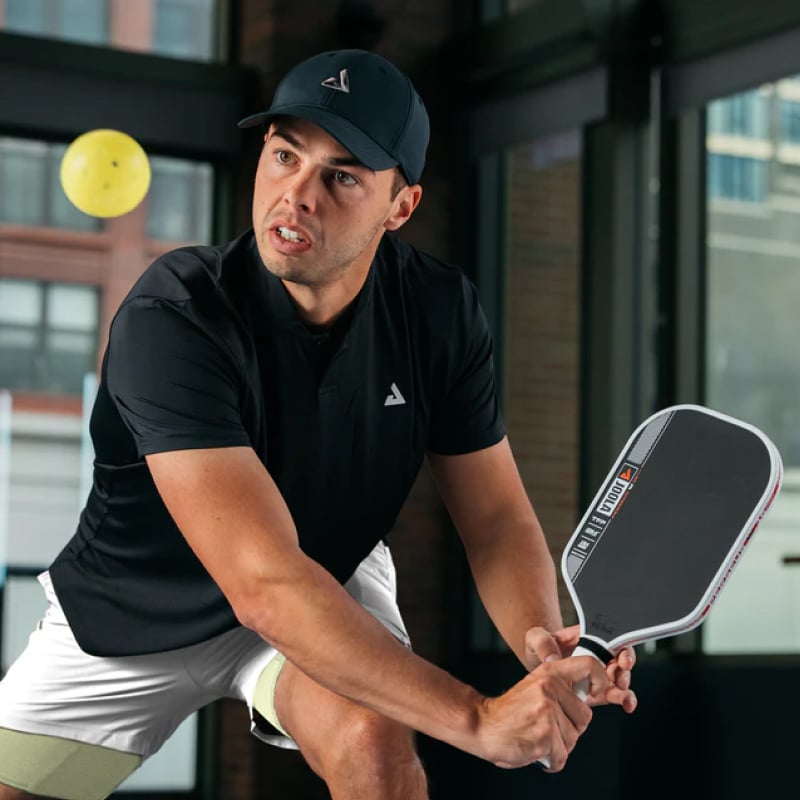
A pickleball paddle is flat, rectangular, and smaller, usually made from graphite, fiberglass, or carbon composite material with a honeycomb core.
It is lighter and weighs between 200 and 250 grams. And the face is smooth rather than textured.
Pickleball paddles sit somewhere between table tennis paddles and padel rackets in feel.
Lighter, flatter, and less cushioned on contact.
Wood and cheap plastic paddles still exist for casual play, but the serious paddles are all carbon fibre composites.
The balls
The balls are where the two sports really diverge.
Padel uses a slightly depressurised tennis ball, so padel balls behave like a standard tennis ball but with a lower bounce under slightly reduced air pressure, which suits the enclosed court and the walls.
Pickleball uses a perforated plastic ball that flies slowly and travels shorter distances.
A tennis ball can bounce up to head height after a firm hit. A pickleball ball often struggles to reach your waist.
Pickleball uses a perforated plastic ball because the designers wanted to make pickleball something children and grandparents could play together without anyone getting hurt.
How to play padel and pickleball
If you’ve played tennis or padel before, pickleball will feel familiar within minutes, though the details are different.
In a game of padel, the serve is played underarm and must bounce in the diagonal service box before it’s struck.
The ball can bounce once before you hit the ball, and you can also play it off the glass walls after the bounce, but not before. A padel game runs to six games per set, just like tennis.
But it is these ricochet shots off the walls that feature in almost every rally, and make the sport distinct.
Pickleball gameplay has its own quirks.
The serve is underarm and must land in the diagonal service box beyond the non-volley line.
After the serve, the return must also bounce before it’s hit (the ‘two-bounce rule’), which stops the serving team dominating through aggressive volleys.
Once those first two bounces are done, pickleball players can volley from anywhere except inside the seven-foot kitchen zone, which is where most of the tactical play happens.
Pickleball can be played as singles or doubles. Though the social side is stronger in doubles and most recreational players stick to that format.
For the full rundown, our step-by-step guides to padel rules and the complete pickleball rules cover everything from serves to scoring edge cases.
Padel scoring and pickleball scores
If you are familiar with tennis, padel scoring is easy to follow. It uses the same scoring system as tennis.
Games go 15, 30, 40, game, with deuce and advantage at 40-40.
Sets are first to six games with a tiebreak at 6-6, and matches are usually best of three sets.
Pickleball scoring is completely different and, for most beginners, easier to follow.
The game is first to 11 points, win by two.
Only the serving team can score, so if the returning team wins the rally, they just win the serve back without earning a point.
The serving team can score several points in a row as long as they keep winning rallies.
Whereas pickleball keeps things simple with first-to-11, padel scoring asks you to track sets, games, and deuces all at once.
Before each serve, the pickleball server calls out three numbers (their team’s score, the opponents’ score, and which partner is serving). The third number can take people a minute to get their heads around, but it quickly becomes second nature.
Is padel or pickleball easier for beginners?
Both sports are designed to be easier to pick up than tennis or squash, but they get there differently.
Padel feels forgiving because of the walls.
If you hit the ball too hard, the back glass brings it back into play. If you mistime a return, your partner has time to cover.
Most beginners can rally within twenty minutes, and within an hour, they’re playing recognisable points.
The learning curve steepens once you start reading shots that come off the glass at strange angles, but the entry point is kind.
Pickleball is even easier for beginners at the very start.
The slower ball gives you time to react, the smaller court means you barely have to move, and the scoring is straightforward enough to follow by your second game.
Plenty of first-timers go from never having held a paddle to playing competitive social games in a single session.
That accessibility is a big part of why pickleball has grown so fast among older players.
Either way, neither will leave you feeling like you wasted your first session.
Fitness differences between padel and pickleball
Padel is a serious aerobic workout.
An average hour of social padel burns between 400 and 700 calories.
Of course, this depends on the intensity of play, with competitive games burning even more. But if you already play squash or tennis, the physical fitness demands will feel familiar.
Pickleball is lower impact, and that’s part of its appeal. An hour of social pickleball typically burns 300 to 500 calories.
The smaller court keeps movement contained, and the slower ball reduces the joint stress you’d get from sprinting around a tennis court. Pickleball gameplay is kinder on the knees than almost any other racket sport.
Padel pushes harder. Pickleball lets you play longer, more often, with less wear and tear.
The social side of racket sports
The social side gets skipped in most pickleball vs padel comparisons, and that’s a mistake.
It’s a big part of why both sports have taken off in the United Kingdom.
Both games are played almost exclusively as doubles.
You turn up, you’re paired with a partner (often randomly for social sessions), and you spend the hour chatting and laughing between points.
Nobody’s playing in silence, and nobody’s grinding out their tenth set.
Padel, over the years, has turned into a post-work social sport across Spain and Latin America, and the UK is following that curve fast.
Pickleball tips further in the social direction.
The slower pace and smaller court mean you can hold a conversation during rallies, which matters if you’re trying to get friends or family involved who don’t normally play sport.
Mixed doubles in pickleball is common and properly mixed in ability, which is rare in racket sports where gaps in experience usually ruin the game.
At our club, the bar and restaurant sit right at the side of the court.
Most people book a two-hour slot, play for an hour, and stay for another hour with food and drinks. The club is built around exactly that routine.

Which sport suits you best, padel or pickleball?
If you’re still not sure whether to go with pickleball or padel, here’s a simple way to think about it.
Go with padel if you played tennis or squash in your twenties and you miss the intensity. If you like long rallies with tactical depth and you want a workout that leaves you satisfied in the best way, padel is the call.
Pickleball is the better pick if you want something easier on your body.
It also suits players who want to get their partner, their parents, or their children involved. Where ability gaps don’t kill the match. And if you’ve never played a racket sport in your life and want a low-stakes entry point, pickleball will feel manageable from the first rally.
Or, our even better option. You don’t have to pick one at all!
Lots of our regulars play both.
Padel on a Tuesday when they want a hard session, pickleball on a Sunday with the family.
Get the best of both worlds! It is the easiest way to work out which sport suits you best.
Give padel or pickleball a go in Glasgow
Get the best of both worlds, here at The Court!
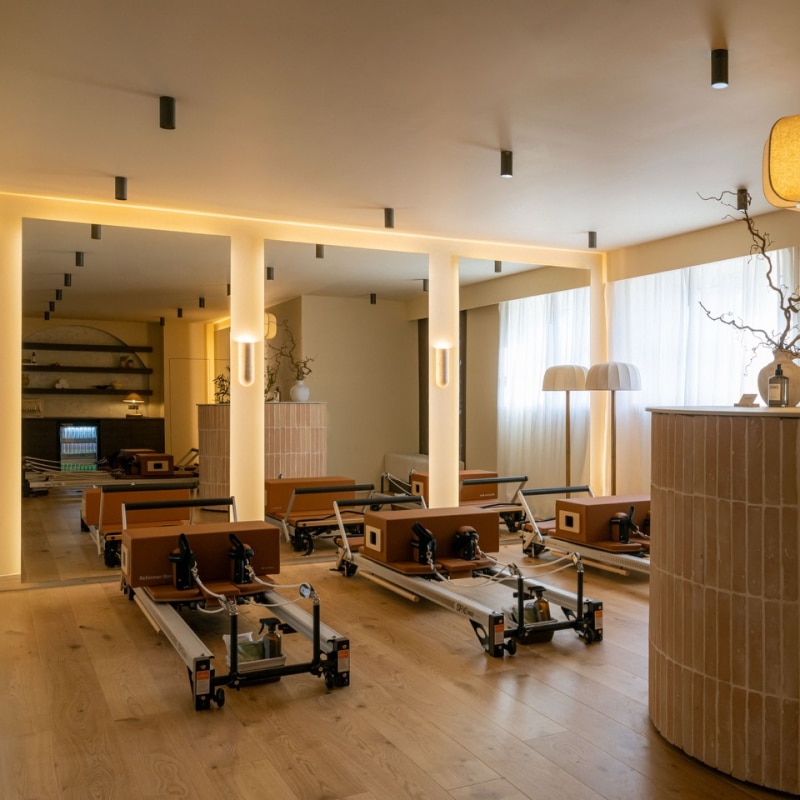
We’ve got 4 padel courts indoors, all panoramic, plus two professional-standard pickleball courts, a Pilates studio, and a full restaurant and bar.
So you can book a padel court in Glasgow one night, grab food afterwards, and come back another day to try pickleball in Glasgow with a different group.
Equipment rental is included, so you don’t need to buy a racket or paddle before your first session. Our coaches run beginner sessions for both sports, which is the fastest way to find padel or pickleball working for you from day one.
Come and play at The Court, and book for a session today! We’ll have a racket and a paddle waiting.