Padel is one of those sports where you can learn the rules in ten minutes and spend years getting better at the game. The basics are straightforward, the scoring works the same as tennis, and the court does half the work for you because the walls keep the ball in play and the rallies going.
This page covers every rule you need to know before stepping onto a padel court for the first time. If you’ve already been playing and just want to settle an argument about whether that shot off the mesh was in or out, you’ll find the answer here too. We’ve written this as a complete rulebook that covers everything from the serve to the golden point, so you can bookmark it and come back whenever you need to check something.
The padel court
Before the rules make sense, it helps to understand the court you’re playing on, because the court itself shapes how the game works.
A standard padel court measures 20 metres long by 10 metres wide. A net divides the court in half, standing 88cm high at the centre and rising to 92cm at the posts on either side. Each half of the court is split into two service boxes by a central line that runs from the net to the service line, and the service line sits roughly 6.95 metres back from the net.

What makes padel unique is the enclosure. The court is surrounded by walls on all sides, and those walls are part of the game. The back walls are made of glass panels, typically 3 metres high, with metal mesh fencing above them that rises to 4 metres. The side walls are a mix of glass and mesh: glass sections sit near the back corners (usually around 3 metres high and 2 metres wide on each side), while the rest of the side walls are metal mesh. Near the middle of the court, sections of the side wall are left open, and that’s where the entry doors are.
The floor surface varies between venues. You’ll find artificial grass, concrete, and synthetic turf, though artificial grass with a sand infill is the most common at purpose-built clubs. The surface affects how the ball bounces and how quickly you can move, so indoor courts with consistent surfaces tend to play more predictably than outdoor ones exposed to weather.
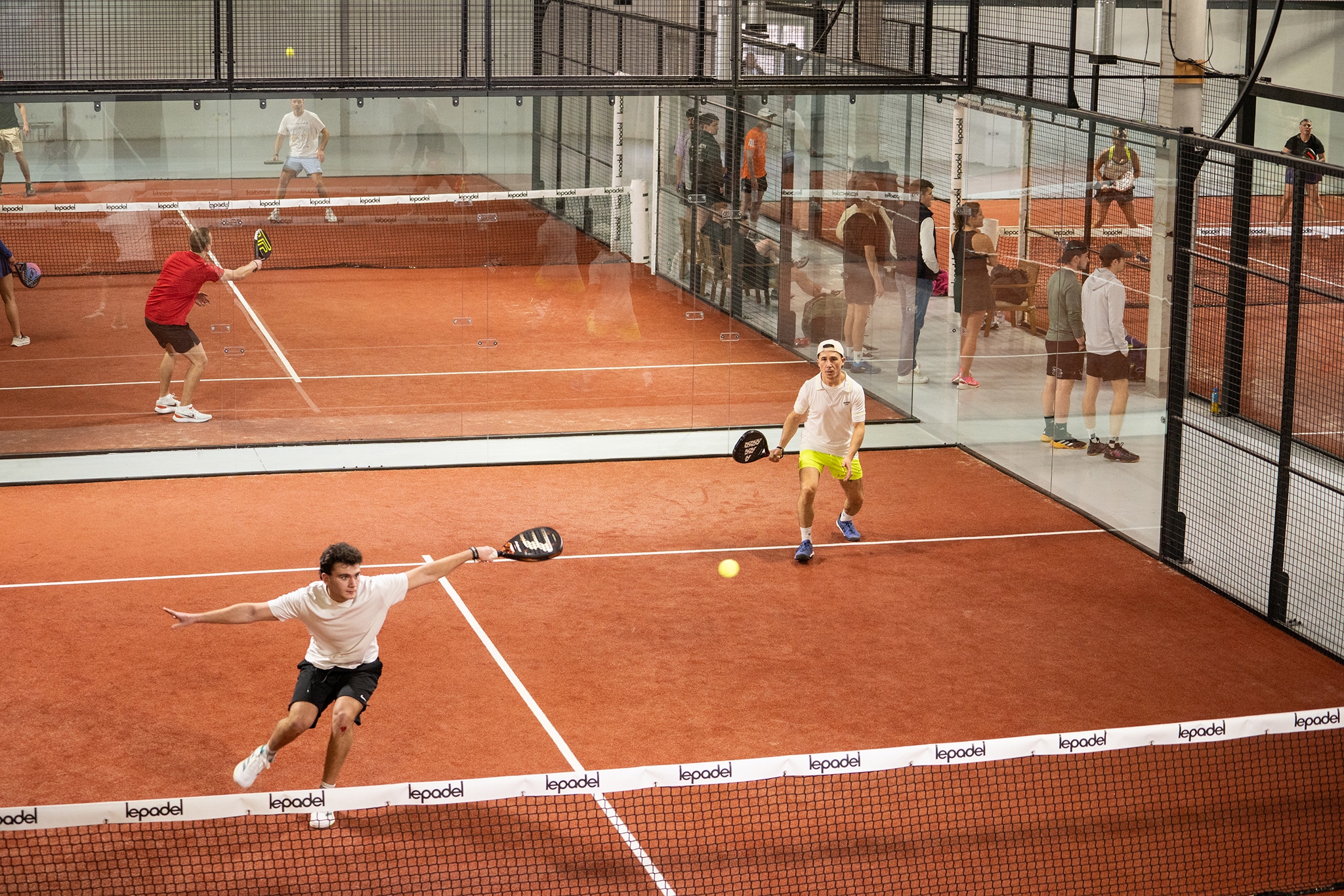
All of the walls, glass and mesh alike, are in play during a rally. The ball can be returned after bouncing off any wall on your side of the court, which is the single biggest thing that separates padel from tennis and gives the sport its tactical depth.
Equipment you need
Padel uses a solid racket (sometimes called a paddle) rather than a strung one. Padel rackets are made from composite materials like carbon fibre or fibreglass, with a foam core and a perforated face covered in small holes. They weigh between 340g and 390g depending on the model, and they’re shorter than tennis rackets with a wider hitting surface. Every racket has a wrist strap that you’re required to wear during play.

The ball looks similar to a tennis ball but is slightly smaller and has less internal pressure, which means it bounces lower and moves more slowly through the air. This is by design. The lower bounce makes wall play more manageable and keeps rallies going longer, which is a big part of why padel feels more accessible than tennis from the very first game.
If you’re trying padel for the first time, you don’t need to buy anything. Most clubs hire out rackets and provide balls, so all you need is sports clothes and a pair of clean non-marking trainers. Indoor court shoes with herringbone soles are ideal, but any gym trainers with a flat, non-marking sole will do the job.

How scoring works in padel
Padel uses the same scoring system as tennis, so if you’ve ever watched Wimbledon, you’re already halfway there.
Points within a game run 15, 30, 40, game. The team that wins four points takes the game. If both teams reach 40 (known as deuce), you need to win two consecutive points to take the game. The first point after deuce is called advantage, and if the team with advantage wins the next point, they take the game. If they lose it, the score goes back to deuce.
A set is won by the first team to reach six games, with at least a two-game lead. So 6-4, 6-3, and 6-0 all win the set, but 6-5 doesn’t. If the set reaches 5-5, you play on until one team leads by two (7-5 wins the set). If it reaches 6-6, you play a tiebreak to decide the set.
In a tiebreak, points are counted 1, 2, 3 and so on rather than 15, 30, 40. The first team to reach 7 points wins the tiebreak and the set, but only if they lead by at least two points. If the tiebreak reaches 6-6, it continues until one team establishes a two-point lead.
A match is best of three sets. Win two sets and you’ve won the match.
The golden point
One rule that’s increasingly common and worth understanding before you play is the golden point. In professional padel (on the Premier Padel and World Padel Tour circuits) and at many clubs, when the score reaches deuce (40-40), there’s no advantage. Instead, a single point decides the game.
Here’s how it works: the receiving team chooses which side of the court the serve goes to (left or right), and the next rally decides the game outright. It speeds matches up considerably and adds genuine pressure to every deuce point, because there’s no safety net of needing to win two in a row.
Some clubs and leagues still use the traditional advantage rule, so it’s worth checking which format your venue plays before you start. At The Court, we can tell you which format we use when you arrive.
Changing ends
Teams switch sides of the court after every odd-numbered game, so after the first game, the third, the fifth, and so on. This ensures that any differences between the two ends of the court (like lighting or slight variations in wall conditions) are shared equally over the match.
During a tiebreak, teams switch ends after every six points. Between sets, you also switch, and there’s a short break before the next set begins.
How to serve in padel
The serve is one of the rules that differs most from tennis, and it’s a big part of what makes padel so beginner-friendly.
In padel, you serve underarm. There’s no overhead motion, no ball toss, and no need for the kind of technique that takes months to develop in tennis. You bounce the ball on the ground and hit it at or below waist height. At the moment of contact, at least one foot must be on the ground, and both feet must be behind the service line.

The serve goes diagonally. The first point of every game is served from the right side of the court into the opponent’s left service box (from the server’s perspective). After every point, the server switches sides, alternating between right and left for the duration of the game.
Once the ball is struck, it must bounce inside the opponent’s service box (the area between the net, the service line, the centre line, and the side wall). After bouncing in the box, the ball can then hit the back glass and still be in play. But if the ball bounces in the service box and then hits the metal mesh or fencing (rather than the glass), the serve is a fault.
Serve rotation
The same player serves for the entire game. At the start of the next game, the serve passes to a player on the opposing team. Across a set, all four players take turns serving. So if Player A serves game 1, Player C (from the opposing team) serves game 2, Player B serves game 3, and Player D serves game 4. The cycle then repeats.

At the start of each set, teams can choose a different serving order if they want. During a tiebreak, serves alternate every two points between all four players.
First and second serve
You get two attempts at each serve, just like tennis. If your first serve is a fault (it misses the box, hits the mesh after bouncing, or you step over the line), you get a second serve. If the second serve is also a fault, that’s a double fault and the receiving team wins the point.
Lets
If the serve clips the top of the net cord and still lands in the correct service box, it’s called a let. The serve doesn’t count and you take it again. You can serve as many lets as needed, and they don’t count against your two attempts.
If the ball clips the net cord and lands outside the service box, it counts as a fault. And if the ball clips the net and hits the wire mesh or fencing after bouncing in the box, that’s also a fault.
The return of serve
The receiving team must let the serve bounce before returning it. You can’t volley the return of serve out of the air. This rule applies to every point: the serve must bounce, and the return of serve must also bounce. After those first two shots, both teams are free to volley.
This is sometimes called the two-bounce rule or the double-bounce rule, and it exists to prevent the serving team from rushing the net and dominating every point from the start. In practice, it means the first two shots of every rally are groundstrokes, and the volleying only starts from the third shot onwards.
The receiving team decides which player returns serve on each side at the start of the set. Once you’ve chosen, you stick with that formation for the entire set. You can switch it up for the next set if you like.
Rules during a rally
Once the serve and return have both bounced, the rally is on and the following rules apply.
Every shot must cross the net and land on the floor on the opponent’s side before hitting any wall or fencing. If your shot hits the glass, mesh, or cage on the opponent’s side before bouncing on the ground, the ball is out and your opponents win the point. This is probably the most misunderstood rule in padel, and it’s worth repeating: the ball must always hit the floor first on the opponent’s side.
On your own side, you can play the ball off any wall after it has bounced on the floor. Back glass, side glass, mesh, the corner where two walls meet. All of it is fair game, provided the ball hit the ground on your side first. You’re also free to volley the ball out of the air at any point during the rally (after the two-bounce rule on the serve and return has been satisfied).
A point is won when the ball bounces twice on your opponent’s side of the court before they return it. A point is lost if the ball bounces twice on your side before you play it.
Wall play: glass, mesh, and corners
This is the heart of padel, and where the game really opens up once you understand what’s happening.
The back glass
The back glass wall is where you’ll play most of your wall shots. When your opponent hits a deep ball that bounces on the floor and then rebounds off the back glass, you have two choices: play the ball as it comes off the glass, or (if it bounces high enough) let it come further off the wall and take it with more time. Beginners often try to hit the ball before it reaches the back wall, but experienced players know that letting the ball come off the glass gives you more time to set up your shot and opens up better angles.
How the ball bounces off the glass depends on the speed and spin of the incoming shot. A hard, flat shot will rebound quickly and come a fair distance off the wall. A slower, spinnier shot might barely come off the glass at all, dying close to the wall and forcing you into an awkward return. Learning to read these bounces is one of the biggest steps in improving at padel.
The side walls
The side walls work the same way as the back wall. If the ball bounces on the ground and then hits the side glass or side mesh, you can still play it. Side wall shots often appear in rallies when the ball is hit with an angle, sending it into the side glass after the bounce. Returning these requires good footwork and an understanding of the angle the ball will take coming off the wall.
Corner play
Some of the most challenging shots in padel are the ones that bounce into the corner where the back wall meets the side wall. The ball can ping off both walls in quick succession, changing direction twice in the space of a metre. Reading corner bounces comes with experience, and it’s one of the things that keeps the game interesting even for players who’ve been playing for years.
Glass vs mesh
Glass walls give a cleaner, more predictable bounce. The ball comes off the glass with pace and a reliable angle. Mesh, on the other hand, absorbs energy and tends to kill the ball’s speed, making it drop sharply. Once you’ve played a few times, you’ll start to anticipate how differently the ball behaves depending on which surface it hits.
On the serve, this distinction matters. A serve that bounces in the service box and then hits the back glass is in play. But a serve that bounces in the box and then hits the mesh or fencing above the glass is a fault. During a rally, both glass and mesh are fair game.
Leaving the court
This is the rule that surprises newcomers most, and the one that produces the most spectacular points in professional padel.
If the ball bounces on your side of the court and then flies over the back wall or out through the open sections near the side doors, you’re allowed to run out of the court through the doors, chase the ball down outside the cage, and play it back over the wall or through any gap in the fencing. The ball is still in play as long as it hasn’t bounced twice on your side. If you can get to it and send it back over the net so that it lands on the opponent’s floor, the rally continues.
You’ll see this happen frequently at professional level, where powerful smashes send the ball sailing over the back glass. Players sprint through the doors, retrieve the ball outside the cage, and lob it back into play. It makes for incredible highlights, and it’s technically within the rules at every level of the game.
At club level, this comes up less often because shots rarely clear the walls with enough height. But knowing the rule means you won’t just stand there watching if a lob does fly over the back glass. Get through the door and have a crack at it.
Faults and how you lose a point
Outside of the serving rules covered above, there are several other ways to lose a point during a rally.
Touching the net
If you or your racket make contact with the net while the point is live, you lose the point immediately. It doesn’t matter if you’ve already hit a winning shot. The ball is allowed to clip the top of the net and continue over (that’s fine), but no part of your body, clothing, or racket can touch it.
Double hit
You can only strike the ball once per shot. If the ball makes contact with your racket twice in the same swing (a double hit), the point goes against you. This is rare in practice, but it can happen on close-range volleys where the ball gets trapped against the racket face.
Body contact
If the ball strikes any part of your body rather than your racket, you lose the point. This includes your doubles partner. If you hit a shot that accidentally clips your partner before crossing the net, the point is lost.
Reaching across the net
You can’t reach over or through the net to play the ball on your opponent’s side. The ball must cross fully to your side before you can make contact. If your racket crosses the plane of the net during a shot, the point is awarded to your opponents.
Hitting the ball out
If you hit a shot that clears the walls entirely without bouncing first on the opponent’s side, the ball is out and you lose the point. A smash that flies straight over the back wall without touching the floor is out. But a smash that bounces on the floor and then carries over the wall is a winning shot, because the opponents needed to return it before the second bounce.
Ceiling contact (indoor courts)
On indoor courts, if the ball hits the ceiling after you strike it, you lose the point. If your opponent’s shot hits the ceiling on your side, the rules vary by venue, so it’s worth clarifying with the club before you play. Most indoor venues play it as the point going against the team that hit the ball into the ceiling.
Obstructions and lets
If the ball goes through a gap in the mesh or fencing, gets stuck in the wire, or is affected by any external interference (a ball rolling onto the court from an adjacent game, for example), the point is replayed as a let.
Common rules that trip people up
Padel rules are straightforward once you’ve played a few games, but there are a handful of situations that regularly cause confusion. Here are the ones we hear debated most often at the club.
“The ball hit the mesh on their side, is that in or out?”
It depends on whether the ball bounced first. If your shot crosses the net, bounces on the opponent’s floor, and then hits the mesh or glass on their side, the ball is in play and they need to return it. If your shot hits the mesh or fencing on the opponent’s side before bouncing on their floor, it’s out and you lose the point. The ground-first rule applies to everything.
“My smash went straight over the back wall.”
If the ball didn’t touch the floor on the opponent’s side before clearing the wall, the ball is out and you lose the point. But if it bounced on the floor and then sailed over the wall, it’s a winning shot because the opponents had their chance to play it.
“The serve hit the back glass and came back towards the net.”
Perfectly legal. As long as the serve bounced inside the correct service box first, it can hit the back glass and do whatever it likes after that. The receiving player still needs to return it before it bounces a second time. What’s not legal is a serve that bounces in the box and then hits the mesh above the glass. That’s a fault.
“Can we both hit the ball?”
Both players on a team can return the ball, but only one player can hit each shot. There’s no set order for who takes which ball, and you can switch freely throughout the rally. Just don’t both swing at the same shot.
“The ball bounced off the back wall, then the side wall, and I still hadn’t hit it.”
That’s fine. The ball can bounce off as many walls as it likes after hitting the floor, as long as it only bounces on the floor once on your side. You could theoretically let it ricochet off three walls before playing it, provided you get to it before the second floor bounce.
“I ran outside to get the ball but it bounced out there.”
The ball has to bounce twice on your side of the court for the point to be over. If the ball bounces once on the court, flies over the wall, and bounces again on the ground outside, that second bounce ends the point, the ball was on the ground twice (once inside, once outside). You need to reach it after the first bounce and before it touches any surface a second time.
How padel rules differ from tennis
If you’re a tennis player picking up padel for the first time, here’s what will feel different.
The serve is underarm in padel, always. No overhead serves, no aces, and the serve is much less of a weapon than in tennis. This levels the playing field between server and returner.
The walls change everything about shot selection. In tennis, a deep shot to the baseline is hard to return. In padel, a deep shot bounces off the back glass and gives your opponent time to set up. Winning points in padel is about placement, patience, and working your opponents out of position rather than hitting outright winners.
Padel is always doubles. The court is designed for four players, and the sport doesn’t have an official singles format (though some clubs run informal singles on modified courts).
The court is smaller (20m x 10m compared to tennis at 23.77m x 10.97m for doubles), so there’s less ground to cover. Padel rewards touch and positioning over speed and power.
The golden point at deuce means padel matches tend to be faster than tennis. No more marathon deuce games that go back and forth for ten minutes.
Club padel vs professional padel
The rules are the same at every level, but there are a few differences in format and convention.
Professional matches almost always use the golden point at deuce. Club matches might use either the golden point or the traditional advantage rule, depending on the venue and the league or tournament format.
Professional padel matches are always best of three sets. Club games might be played as a single set, a timed session (say, 60 or 90 minutes), or first to a set number of games, depending on how busy the courts are.
In professional padel, the server has 25 seconds to start the next point after the previous one ends. At club level, there’s no formal time limit, but keeping things moving is just good etiquette.
Coaching isn’t allowed during professional matches. At club level, there’s nothing stopping your partner from giving you tips between points, and that’s part of the fun.
Your questions about padel rules answered
How many players do you need for padel?
Four. Padel is a doubles sport, two players per side. If you’ve only got two or three people, social sessions at The Court will match you with other players so you can still get a game.
Can you volley in padel?
Yes, once the serve and return have both bounced (the two-bounce rule), you can volley the ball out of the air from anywhere on the court. There’s no non-volley zone like the kitchen in pickleball.
What happens if the ball hits the ceiling?
On indoor courts, the point is lost by the team that hit the ball into the ceiling. If you’re playing outdoors, there’s no ceiling to worry about, though particularly high lobs may be affected by wind.
Can the ball bounce off multiple walls before I hit it?
Yes. After bouncing on the floor on your side, the ball can hit the back glass, the side wall, the corner, and keep going. As long as it doesn’t touch the floor a second time, you can play it off any number of walls.
What happens if the ball breaks during a point?
The point is replayed as a let.
Do you switch sides in padel?
Yes. Teams change ends after every odd-numbered game (after the 1st, 3rd, 5th, and so on). During a tiebreak, you switch every six points.
Is padel always played as doubles?
Officially, yes. Padel was designed as a doubles sport and the rules are written around four players. Some clubs offer informal singles play on a regular court, but it’s not an official format and the court feels very different with only two people on it.
Who chooses which side to receive serve on at deuce with the golden point?
The receiving team. They pick whether the serve comes to the left or right side of the court, then one rally decides the game.
Can I use any racket?
You need a padel-specific racket (solid face with holes, no strings, with a wrist strap). Tennis rackets, squash rackets, and pickleball paddles aren’t suitable. If you don’t have a padel racket, most clubs have them available to hire.
What’s the difference between a fault and a let on serve?
A fault is a failed serve (missed the box, hit the mesh, foot over the line). A let is a serve that clips the net cord and still lands in the correct service box, so you retake it without penalty. If it clips the net and misses the box, it’s a fault.
What if I accidentally hit the ball twice in one swing?
It’s a double hit and you lose the point, even if it was unintentional.
Can I switch which partner returns serve on which side?
You choose your formation at the start of each set and stick with it for that set. At the start of the next set, you can change if you want to.
Try padel at The Court
The rules make a lot more sense once you’re in the middle of a rally, watching the ball come off the glass and working out your next shot. That’s when padel stops being a list of rules and becomes one of the most enjoyable sports you’ve ever played.
The Court has four indoor panoramic padel courts in Glasgow, open seven days a week from 8am to 11pm (Monday to Saturday) and 9am to 9pm on Sundays. You can book a court on Playtomic without needing a membership, and we have rackets and balls available if you don’t have your own equipment. If you’d rather learn the rules on court with a coach walking you through it, our coaching sessions cover everything from the serve to wall play to doubles positioning.
Book your first game and come see what the fuss is about. Once you’ve played a couple of rallies, you won’t need to read this page again.