Pickleball looks complicated for about five minutes. There’s a strange name, a plastic ball with holes in it, and people shouting three numbers before every serve. However, the sport is actually pretty straightforward, and once you have learnt the basics you will be up and running in no time!
This page breaks down every pickleball rule you need to know, from the serve to the kitchen to the scoring system that confuses every beginner for the first game or two. Whether you’ve never held a paddle or you’ve played a few times and still aren’t sure what “0-0-2” means, this is the guide to bookmark.

The pickleball court
A pickleball court is the same size as a badminton court: 6.1 metres wide by 13.4 metres long (or 20 feet by 44 feet if you prefer imperial). The court is the same dimensions for both singles and doubles, so there’s no extra space when four people are playing, which is part of what makes pickleball so fast and fun at the net.
The net runs across the middle of the court. It stands 91cm (36 inches) high at the sidelines and dips slightly to 86cm (34 inches) at the centre, which is lower than a tennis net but higher than a badminton net.
Each side of the court is divided into two service boxes by a centreline, and there’s a line running 2.1 metres (7 feet) from the net on each side. The area between that line and the net is the non-volley zone, better known as the kitchen. We’ll get into why the kitchen matters shortly, because it’s the rule that gives pickleball most of its character.
The baseline is the line at the very back of the court, and the sidelines run down either side. Any ball that lands on a line is considered in. The only exception is the serve: a serve that hits the kitchen line (the non-volley zone line) is a fault, even though it technically landed on a line.
Equipment you need
Pickleball uses a solid paddle rather than a strung racket. Paddles are made from composite materials like graphite, carbon fibre, or fibreglass, with a polymer core. They’re larger than a table tennis bat but smaller and lighter than a tennis racket, and they don’t have strings. The face of the paddle has a textured surface that helps put spin on the ball.
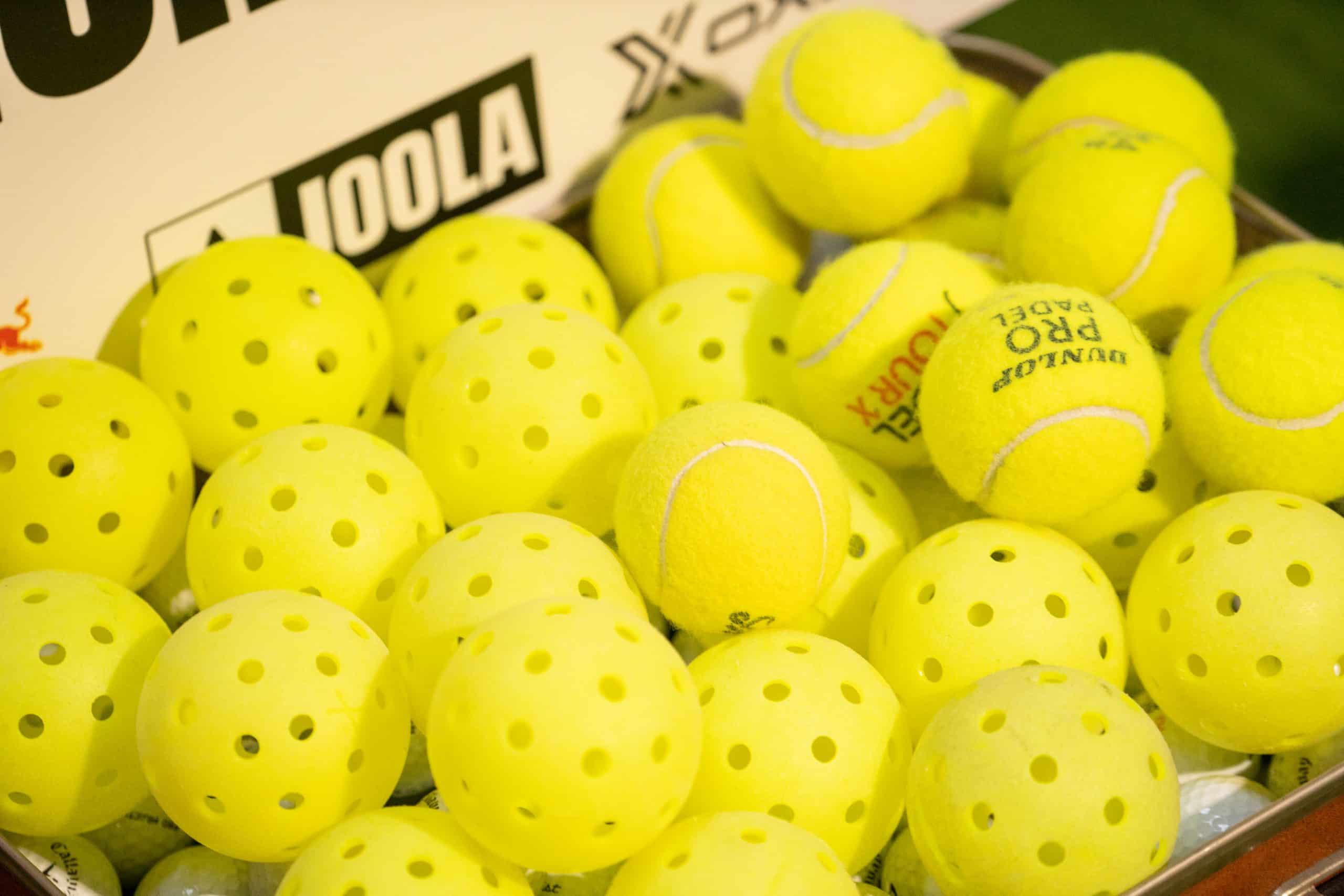
The ball is lightweight, hollow, and made of hard plastic with holes punched through it. Indoor balls and outdoor balls are slightly different: indoor balls tend to have larger, fewer holes and are a bit softer, while outdoor balls have smaller, more numerous holes and are slightly harder to cope with wind. The rules are the same regardless of which ball you use, but the way the ball flies and bounces changes a little between the two.
If you’re playing for the first time, you don’t need to buy anything. Most clubs provide paddles and balls, so all you need is sports clothes and a pair of clean, non-marking trainers. Court shoes with good lateral support are ideal, but any flat-soled gym trainers will work.
How scoring works in pickleball
This is the part that trips up every beginner, so let’s take it one step at a time.
Pickleball games are played to 11 points. You must win by at least 2 points, so if the score reaches 10-10, play continues until one team leads by two. In tournament play, some games are played to 15 or 21, but 11 is standard for club and social play.

Only the serving team can score points. If the serving team wins a rally, they get a point. If the receiving team wins a rally, no point is scored, but the serve changes hands (this is called a side-out). This means you need to win the rally when you’re serving to actually add to your score, and when you’re receiving, you’re playing to win back the serve.
The three-number score
In doubles (which is how most pickleball is played), the score is called as three numbers before every serve. The first number is the serving team’s score, the second is the receiving team’s score, and the third is the server number (1 or 2).
So if you hear “4-2-1,” it means the serving team has 4 points, the receiving team has 2 points, and it’s the first server’s turn. If that server loses the rally, the serve passes to their partner (the second server), and the score would be called as “4-2-2.” If the second server then loses a rally, it’s a side-out and the other team starts serving.
This three-number system is unique to pickleball and it takes a game or two before it feels natural. Don’t worry about it too much on your first session. Everyone gets confused by it, and your opponents will usually help you out.
Why the game starts at 0-0-2
At the very start of a match, the score is called as “0-0-2” rather than “0-0-1.” This means the first team to serve only gets one server (the second server) before the serve passes to the other team. The reason is fairness: since the team that serves first has an inherent advantage (they get to score before the other team even touches the ball), starting with only one server instead of two helps balance things out. After that initial serve, both teams get two servers per turn for the rest of the game.
Singles scoring
In singles, scoring is simpler. There are only two numbers called (your score and your opponent’s score), and there’s no server number because there’s only one player per side. When your score is even (0, 2, 4, 6, 8, 10), you serve from the right side of the court. When it’s odd (1, 3, 5, 7, 9), you serve from the left. This is because the serve always goes diagonally, and your court position reflects your score.
How to serve in pickleball
The serve in pickleball is underarm, which removes the biggest barrier that stops beginners from enjoying racket sports. There’s no overhead motion, no ball toss, and no technique that takes months to develop. You can get a legal serve over the net within minutes of picking up a paddle.
To serve, you stand behind the baseline on the right side of the court (for the first point) and hit the ball diagonally into the opponent’s service box on the other side. The paddle must make contact with the ball below your waist, and the paddle head must be below your wrist at the point of contact. Your arm swings upward in an underarm motion. At least one foot must be behind the baseline when you strike the ball, and you can’t step on or over the baseline until after contact.
The serve must clear the net and land in the correct diagonal service box. It must not land in the kitchen (the non-volley zone). A serve that hits the kitchen line is a fault, even though line balls are normally considered in during the rest of the game.
If the serve clips the net and still lands in the correct service box (clearing the kitchen), it’s a let and you retake the serve. There’s no limit to how many lets you can serve.
The drop serve
There’s an alternative serving method called the drop serve. Instead of hitting the ball out of your hand, you can drop the ball from any natural height (you can’t throw it downward) and hit it after it bounces. With a drop serve, the restrictions on paddle position (below waist, head below wrist) don’t apply because the ball has already bounced, which makes it a bit easier for beginners who find the standard volley serve tricky to coordinate.
Serve rotation in doubles
The serve rotation in doubles is where most of the initial confusion comes from, but it follows a logical pattern once you understand it.
At the start of each service turn, the player on the right side of the court serves first (this is the first server, hence server number 1). If the serving team scores a point, the server and their partner swap sides and the same player serves again, this time from the left side to the opposite diagonal box. They keep serving and swapping sides with their partner after every point until they lose a rally.
When the first server loses a rally, the serve passes to their partner (the second server, number 2), who serves from whichever side they’re currently on. If the second server also loses a rally, it’s a side-out and the serve goes to the other team.
The receiving team doesn’t switch sides. Only the serving team swaps after scoring a point.
The double-bounce rule
This is one of the rules that makes pickleball different from most other racket sports, and it exists for a good reason.
After the serve, the ball must bounce once on the receiving side before it’s returned. Then, the return must bounce once on the serving side before the serving team can play it. That’s two bounces, one on each side, before anyone is allowed to volley the ball (hit it out of the air).
The rule exists to prevent the serving team from rushing the net immediately after serving and dominating the point with volleys. By forcing both teams to play a groundstroke on each of the first two shots, the double-bounce rule creates a more even start to every rally and gives the receiving team a fair chance to get into position.
After the two bounces have happened (the serve has bounced and the return has bounced), both teams are free to volley the ball from anywhere on the court except the kitchen. This is when the pace of the rally picks up and the net game begins.
The kitchen (non-volley zone)
The kitchen is the 2.1-metre (7-foot) zone on each side of the net, marked by a line running parallel to the net. It’s the rule that gives pickleball its tactical depth, and the one that produces the most debates on court.
The rule is straightforward: you cannot hit the ball out of the air (volley it) while standing in the kitchen or touching the kitchen line. If the ball bounces inside the kitchen first, you can step in and play it off the bounce, that’s fine. But if you want to volley the ball (take it before it bounces), both feet must be behind the kitchen line, and you must be firmly planted, not moving into the zone.
The momentum rule
This is the part that catches people out. If you volley the ball from just behind the kitchen line and your forward momentum carries you into the kitchen after the shot, it’s a fault, even if you hit a winning shot. Even if the rally is over and the ball is dead before your foot touches the kitchen floor, the fault still counts. Your momentum from a volley cannot carry you into the non-volley zone under any circumstances.
This applies to anything you’re wearing or carrying too. If you volley the ball and your hat falls off into the kitchen, or your paddle slips out of your hand and slides into the zone, it’s a fault. The rule is strict because without it, players would charge the net and smash everything, and the strategic soft game that makes pickleball so interesting would disappear.
What you can do in the kitchen
You can stand in the kitchen whenever you like. There’s no rule against being in the zone, only against volleying while you’re there. If the ball bounces in the kitchen (a short shot or a dink that drops into the zone), you can step in, let it bounce, and play it back. Many rallies in pickleball involve both teams standing at the kitchen line, dinking the ball softly back and forth, waiting for someone to pop the ball up high enough to attack.
You can also enter the kitchen after a volley if you’ve re-established your position first. Hit the volley behind the line, plant both feet, stop your forward momentum, and then you can walk into the kitchen if you need to. The fault only happens when your volleying motion or momentum carries you into the zone.
Rules during a rally
Once the serve, return, and double-bounce obligations have been met, the rally continues until one team commits a fault or the ball bounces twice.
A shot is in if it lands inside the court boundaries or on any line (baseline, sideline, or centreline). During a rally (not the serve), a ball that clips any part of any line is in.
A shot is out if it lands outside the boundary lines. If a ball lands out, the team that hit it loses the rally.
If the ball hits the net and goes over during a rally, play continues. There’s no let rule during rallies, only on the serve.
You can only strike the ball once per shot. If the ball hits your paddle twice in the same swing, it’s a fault.
If the ball hits a player (anywhere on their body, clothing, or anything they’re carrying), it’s a fault against that player, regardless of where they’re standing. This is true even if the ball would have gone out. Once it touches you, the rally is over.
Faults: how you lose a rally
A fault ends the rally. If the serving team commits a fault, the serve passes (either to the second server or to the other team as a side-out, depending on whether it was the first or second server). If the receiving team commits a fault, the serving team scores a point.
Here are the ways a fault is committed:
Hitting the ball out of bounds. Any shot that lands outside the sidelines or baseline is out.
Hitting the ball into the net. If your shot doesn’t clear the net, the rally is over.
Volleying in the kitchen. Hitting the ball out of the air while standing in the non-volley zone, touching the kitchen line, or being carried into the kitchen by momentum after a volley.
Violating the double-bounce rule. Volleying the ball before both bounces have occurred (the serve bounce and the return bounce).
Hitting the ball before it crosses the net. You can’t reach across the net to play the ball on your opponent’s side.
The ball hitting you. If the ball strikes any part of your body or anything you’re wearing, it’s a fault against you.
A serve that hits the kitchen line. Unlike during rallies where line balls are in, a serve that touches the non-volley zone line is a fault.
A serve that lands in the wrong box, out of bounds, or doesn’t clear the net. Standard serving faults.
Foot faults on the serve. Stepping on or past the baseline before making contact with the ball.
Doubles rules in detail
Doubles is by far the most popular way to play pickleball, and there are a few rules specific to the doubles format beyond the basic rules covered above.
At the start of the game, the team that serves first gets only one service turn (starting at 0-0-2). After the first side-out, both teams get two service turns per possession.
When the serving team scores a point, the server and their partner switch sides. The server then serves from the opposite side of the court. The receiving team never switches sides during a service turn.
Both players on a team can hit the ball during a rally, but only one player can hit each shot. There’s no set order for who takes which ball, and partners can move freely around the court.
Positioning at the start of each point is determined by the score and the serve rotation. The server always starts behind the baseline on the correct side (right if the score is even, left if odd), and the receiving player stands diagonally opposite. Partners can position themselves anywhere on their side of the court.
Singles rules
Singles pickleball follows the same basic rules with a few simplifications.
There’s no server number, so the score is called as two numbers instead of three (server’s score, then receiver’s score). The server serves from the right side when their score is even and from the left when it’s odd. The receiver positions themselves diagonally opposite.
Only one serve attempt is allowed per point (no first and second server rotation, since there’s only one player per side). If you lose the rally on your serve, the serve passes to your opponent.
The court dimensions stay the same, the kitchen rules are identical, the double-bounce rule still applies, and games are still played to 11 with a two-point winning margin. The main difference is that singles is far more physically demanding because you’re covering the entire court on your own, and rallies tend to involve more running and fewer soft exchanges at the kitchen line.
Common rules that trip beginners up
Pickleball rules are simple once you’ve internalised them, but there are a handful of situations that cause confusion in every beginner’s first few games.
“I scored a point but the other team was serving.”
You can’t. Only the serving team can score in standard pickleball. If you win a rally while receiving, you don’t get a point, but you do win the serve back (a side-out). You need to be serving to add to your score.
“My partner served, lost the rally, and now the other team serves?”
Not yet. In doubles, both players on a team serve before the serve passes to the opponents. If the first server (server 1) loses a rally, the serve goes to their partner (server 2). Only when the second server also loses a rally does the serve transfer to the other team.
“What’s 0-0-2 and why don’t we start at 0-0-1?”
At the start of the match, the serving team only gets one server (the second server, number 2) before the first side-out. This slight disadvantage offsets the advantage of serving first. After that, both teams use both servers normally.
“I volleyed the ball just behind the kitchen line and then stepped forward.”
If your momentum from the volley carried you into the kitchen, it’s a fault, even if the ball was already dead. You need to stop your forward movement completely behind the kitchen line after a volley before stepping into the zone.
“The ball bounced in the kitchen during the serve.”
That’s a fault. The serve must clear the kitchen entirely, including the kitchen line. During a rally, the kitchen is a perfectly legal landing spot for the ball.
“Can I stand in the kitchen during a rally?”
Yes. You can stand in the kitchen whenever you like. You just can’t volley the ball (hit it out of the air) while you’re in there. If the ball bounces in the kitchen, you can step in and play it off the bounce.
“The ball hit the net on my serve and went in.”
If it landed in the correct service box (clearing the kitchen), it’s a let and you reserve. If it hit the net and landed in the kitchen, out of bounds, or in the wrong box, it’s a fault.
“My shot was going out but it hit my opponent.”
Doesn’t matter. If the ball touches any part of a player before landing out, the rally is over and the fault is against the player who was hit. This catches people out because the instinct is to avoid the ball, but if it clips you, you lose the rally.
Pickleball vs other racket sports
If you’re coming from tennis, the biggest adjustment is the serve (underarm only), the kitchen (no equivalent in tennis), and the scoring (points only on serve, three-number system). The court is much smaller, so there’s less running but more emphasis on placement and soft touch at the net.
From badminton, the court size will feel familiar since it’s identical. But the ball behaves very differently from a shuttlecock, travelling faster with a lower arc, and the kitchen adds a tactical dimension that badminton doesn’t have.
From padel, the most obvious difference is that there are no walls. Pickleball is played on a flat, open court, and the ball can’t be played off any surrounding structure. The kitchen serves a similar purpose to padel’s net-play dynamics, forcing players to use soft shots and think tactically rather than relying on power. If you play both sports at The Court, you’ll notice how the skills transfer, particularly around net positioning and touch.
Your questions about pickleball rules answered
How many people do you need to play pickleball?
You can play singles (1v1) or doubles (2v2). Doubles is more common and what most beginners start with. If you don’t have a group of four, social sessions at The Court match you with other players.
Can you hit the ball overarm?
Yes, during a rally. The only shot that must be underarm is the serve. Once the ball is in play, you can hit it however you like, including overhead smashes, as long as you follow the kitchen rules.
What happens if the score reaches 10-10?
Play continues until one team leads by 2 points. There’s no tiebreak or sudden death (in standard scoring). You just keep playing until someone pulls ahead by two.
Can I use a tennis racket or a padel racket to play pickleball?
No. You need a pickleball-specific paddle (solid face, no strings). Tennis rackets and padel rackets aren’t allowed. If you don’t have one, most clubs provide paddles for hire.
What’s the difference between indoor and outdoor pickleball?
The rules are identical. The difference is the ball: indoor balls have larger, fewer holes and are softer, while outdoor balls are harder with more, smaller holes. Outdoor courts may also be subject to wind, which adds an extra variable.
Can I serve overarm?
No. The serve must be underarm, with contact below the waist and the paddle head below the wrist at contact (unless you’re using the drop serve, in which case those restrictions don’t apply after the bounce).
Is the kitchen line in or out on a serve?
Out. A serve that touches the kitchen line is a fault. During all other play, lines are in.
What if I drop my paddle in the kitchen after a volley?
It’s a fault. Anything you’re wearing or carrying that enters the kitchen as a result of volleying momentum counts as a kitchen violation.
Do I switch sides after scoring?
In doubles, the server and their partner switch sides after scoring a point, and the same person serves again from the new side. The receiving team doesn’t switch.
Can both doubles partners stand wherever they want?
During a rally, yes, you can move freely. At the start of a point, the server must be behind the baseline on the correct side, and the receiver must be in position to receive diagonally. Partners can stand anywhere on their side.
What happens if the ball hits the net post?
If the ball hits the net post and lands in the correct court, it’s in play. The net post is considered part of the net for this purpose.
Is there a time limit on serving?
In tournament play, the server has 10 seconds after the score is called to serve. At club level, there’s no formal timer, but keeping a reasonable pace is good etiquette.
Try pickleball at The Court
The rules read like a lot on paper, but they click into place the moment you start playing. Within a game or two, the scoring will feel natural, the kitchen will make sense, and you’ll be focused on where to place your next dink rather than whether you’re standing in the right spot.
The Court has two professional-standard indoor pickleball courts in Glasgow, open seven days a week. You can book a court on Playtomic without a membership, and we have paddles and balls available if you don’t have your own. If you’d rather learn the rules on court with someone walking you through it, our coaching sessions cover everything from the serve to kitchen strategy to doubles positioning.
Book a court and come see why pickleball is the fastest-growing sport in the country. You’ll wonder why you didn’t try it sooner.