It’s the fastest growing sport in the UK for a reason. It’s addictive from the first session.
Whether you want to fast-track your way to winning matches or simply learn the rules and build some rallies, coaching is the quickest way to get there.
We run the coaching programme at The Court in Glasgow, and we see the same thing every week. New players walk in nervous and walk out already booked in for next week.
This guide covers what padel coaching for beginners actually involves, what you’ll learn in your first few lessons, and how to decide between group sessions and one-to-one coaching.
If you want to start playing padel properly, you have found the place to start.
Do you need padel coaching, or can you just start playing padel?
You don’t need coaching, but it makes everything faster.
Padel is one of the easier racket sports to pick up without formal lessons.
The rules are simple, the court is small, and the walls forgive mistakes.
Plenty of people have a few social games, watch YouTube tutorials, and get reasonable within a month or two.
That said, a structured coaching session with a padel coach fixes three things that are almost impossible to fix on your own.
If you’re serious about playing padel as a regular sport rather than an occasional thing with mates, one or two beginner lessons will pay back quickly.
Some of the things our coaches address first include:
Grip and ready position
Wrong grip is the single most common beginner mistake, and it stops you from learning proper volleys and smashes for months if nobody corrects it.
Court positioning
Where to stand on a padel court is counter-intuitive if you’ve played tennis. A coach gets you into the right spot within one lesson.
Reading the walls
Knowing when to let the ball bounce off the back glass and when to take it early is a timing thing that’s easier to learn with a coach calling it out in real time than from watching videos.
What padel coaching for beginners covers
A good introduction to a padel coaching session for a complete beginner covers the following, usually across one to three lessons, depending on pace.
Rules and padel court basics
Your coach will walk you through the rules, the scoring system, the service rules, the two-bounce rule on the return, and how the walls come into play.
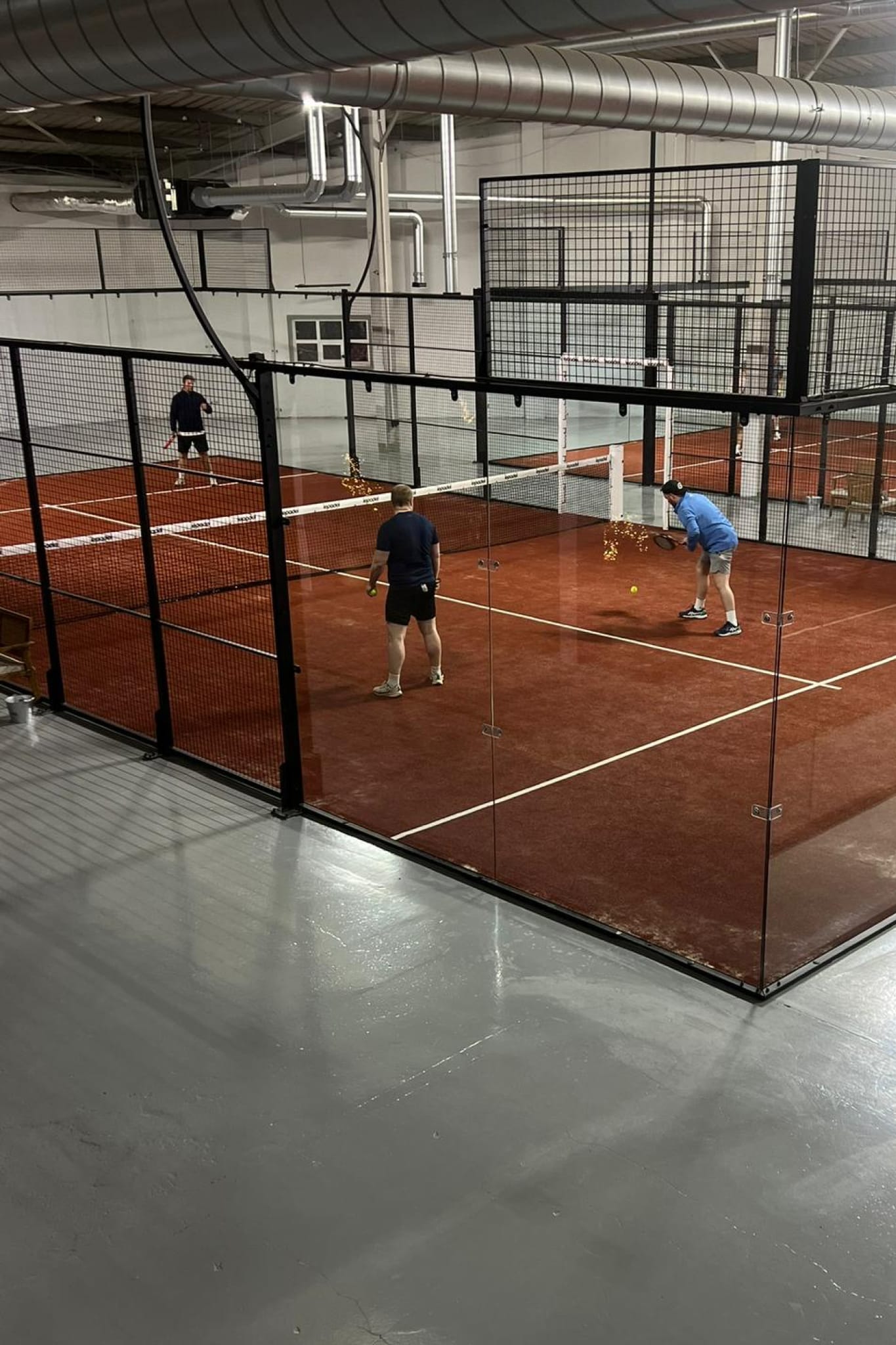
The padel court is an enclosed court about a third the size of a tennis court, with glass at the back and mesh above the side walls.
Understanding where the lines sit and what counts as in or out is the foundation for everything else.
Grip and ready position
Almost every beginner holds the racket wrong in their first lesson.
A padel coach will show you the continental grip (similar to the grip used for a tennis volley) and put you into a balanced ready position.
Feet shoulder-width apart, racket held in front with both hands, knees slightly bent.
It feels awkward for the first ten minutes. But once it clicks, it becomes second nature, and the foundation everything else is built on.
Forehand and backhand
You’ll learn the basic forehand and backhand drives, using a short swing and letting the racket do the work.
Padel strokes are closer to a tennis volley than a groundstroke. They are compact, more slice than topspin, and aimed at placement rather than power.
The volley
Once you’ve got the grip and the ready position sorted, volleys are next.
A padel volley is essentially a blocked shot at the net, played with minimal swing.
Your coach will feed balls for you to volley back in sequence, teaching you to watch the ball onto the strings and step forward into the shot.

Lob shots
The lob is the most important shot in padel, and beginners usually learn a basic version in their second or third lesson.
You’ll work on lifting the ball over your opponents’ heads to the back of the court, with an emphasis on arc and depth rather than power.
A lob that lands deep forces the other team back off the net, which is the whole point of the shot.
Using the walls
Once you can rally, your coach will feed balls into the back glass so you can practise letting the bounce come off the wall and hitting a controlled return.
The first time you do this properly is when padel clicks for most new players.
The walls stop being scary and start being useful.
Footwork and basic positioning
Padel footwork is about small, reactive steps rather than big tennis-style movements.
Your coach will drill footwork patterns for moving between defensive and attacking positions, getting to the net with your partner, and splitting the court in doubles.
Good footwork is what separates a beginner who can hit shots from a beginner who can play points.
Group padel coaching vs private padel lessons
Once you’re ready to start learning or looking to improve, you typically have two coaching options: private lessons or group sessions.
Group coaching programmes
Group coaching is the cheapest way in and usually the most fun.
Padel is a social sport, and learning it that way makes sense.
Bonding over drills, playing points together, and improving as a group is a great way to fall in love with the game. Because everyone is new and at a similar level, you rally naturally and learn by doing.
Most clubs run beginner and intermediate group sessions, so as you improve, you can move up and keep playing with people at the right level.
Private padel lessons
For a slightly more expensive way to learn, but where you’ll improve the fastest, private sessions are the way to go.
You get the coach’s full attention for 45 to 60 minutes, the drills are personalised to your game, and you cover more ground per lesson than in a group.
Worth it if you want to fix a specific problem, if you’re preparing for a tournament, or if you simply prefer to learn without an audience.
How long until you’re match-ready?
Most beginners are ready to play social padel matches with confidence on the court within 3-5 sessions. That’s roughly 5-8 hours of coached time.
This will help you know the rules, be able to serve legally, move in the right directions, and have fun at a social club night without feeling lost.
To be properly competitive at club level, expect 10-20 lessons plus regular play. That’s 3-6 months of weekly coaching and weekly matches.
The players who progress fastest at our club are the ones who combine coaching with social play rather than doing either alone.
Lessons teach you what to do. Matches teach you when to do it.
How to book a padel coaching session
Through the club directly
Most dedicated padel clubs handle coaching bookings through their own website, phone, or reception desk. This is the easiest route for recurring lessons where continuity matters.
We recommend booking your first lesson through the club directly so you can talk to someone about your level, goals, and which coach would suit you best.
Through the Playtomic app
Playtomic, the main padel booking platform in Europe, lists coaching sessions at many UK clubs. You can see available slots, coach profiles, and prices in one app.
Whether you want to play padel or pickleball, download the Playtomic app, find courts near you, and filter by “coaching” to see what’s available.
Ready to play? Book your first padel coaching session
Learning padel is faster and more fun with structured coaching behind you, and there’s no better place to start your padel journey than with a qualified coach at a purpose-built club.
Whether you’re booking a group session to meet other new players, or book a 1:1 to fast-track your learning, our academy course to go from zero to match-ready and the investment pays back quickly.
At The Court Glasgow, we’ll have everything you need to know covered in your first session.
Book a coaching session via the Playtomic app, or get in touch about our membership options if you’d like coaching bundled with regular play. The fastest growing racket sport in the UK is more fun with a coaching team behind you.