The first thing most people notice when they watch padel through the glass walls is that it looks manageable.
No booming overhead serves, no sprinting to a far corner after a ball that’s already bounced twice.
The ball comes off the back glass, rallies keep going, and even complete beginners end up winning points within their first session.
Once you’ve played it, you understand why people who try it tend to book again the same week.
Padel is a doubles racket sport played between four players on an enclosed court.
This beginner’s guide covers everything you need to know to start playing padel: the court, the basic equipment, the serve, the padel rules, and how to use the walls.
All written by true padel and pickleball experts.
The padel court appearance
A padel court looks like a smaller version of a tennis court, measuring 20 metres long by 10 metres wide.
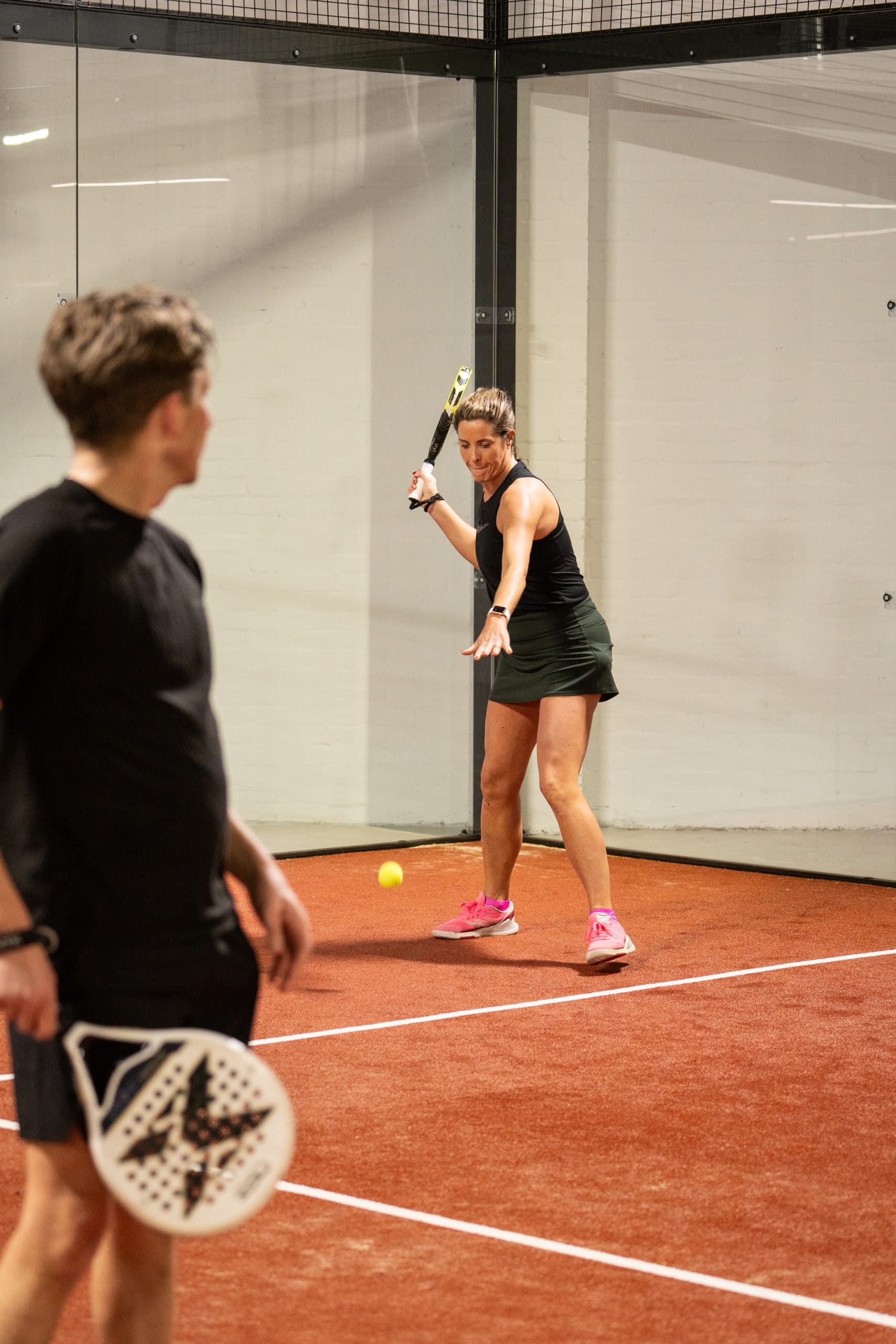
Unlike an open tennis court, a padel court is surrounded by glass walls and metal mesh fencing rising to around 4 metres at the back and sides.
A net dividing both sides sits at 88cm in the centre and 92cm at the posts.
The court is smaller than a standard tennis court, which makes movement manageable even if you haven’t played sport in a while.
Those glass walls change the game entirely. After the ball bounces on the floor, it can hit the side or back wall and remain in play, so shots that would be out on a tennis court stay alive in padel.
Rallies last longer, beginners can keep the ball going more easily, and the enclosed court creates a controlled game rather than a chaotic one.

What you need to play padel
The basic equipment you need to play padel is a racket and a ball. The padel racket, called a pala, is shorter than a tennis racket and has a solid face with no strings at all.
The face is made from carbon fibre or fibreglass with a foam core and small perforations.
Most rackets weigh between 340 and 390 grams.
The solid face makes padel easy to pick up quickly, because off-centre hits are far more forgiving than on a strung racket.
The ball looks similar to a tennis ball but has lower internal pressure.
It bounces lower and moves more slowly, which helps beginners keep the rally going and makes wall play controllable.
If padel used a full-pressure tennis ball, shots coming off the back glass at pace would be almost impossible to deal with.
You don’t need your own kit to play padel.
At The Court, we hire out rackets at the pro shop, so you can walk in and play without spending anything on equipment upfront.
How the serve works
The padel serve is the simplest serve in any racket sport.
Every point begins with an underarm serve from the right-hand service box, struck diagonally into the opponent’s service box on the far side of the net.
The server lets the ball bounce once before hitting it at or below waist height.
No overhead motion, no throw-up, and no technique that takes weeks to develop. A
nyone new to padel can manage a legal serve within their first few minutes on court.
A valid serve lands in the opponent’s service box.
A serve is considered a fault if it lands outside the service box, hits the net without crossing, or bounces into the wire fencing before the receiver can play it.
A serve that clips the net cord and still lands in the correct box is replayed. Two faults hands the point to the receiving pair.
Padel scoring and the basic padel rules
Padel uses the same scoring system as tennis: 15, 30, 40, and game.
Like in tennis, games are played to deuce at 40-40, but the official rules apply the golden point rule, where whoever wins the next point takes the game outright.
The receiving pair chooses which player faces the golden point and from which side.
Sets run best-of-three-sets format. To win a set, the first team must win six games and lead by at least two games.
At 6-6, a tiebreak decides the set. The tiebreak is won by the first pair to reach seven points with a lead of at least two points. The first team to win two sets takes the match.
Official padel rules in play
Once a rally is underway, the ball must bounce once on your side of the court before you can let the ball hit the back wall, or you can volley it before it bounces.
The ball may not bounce twice.
A team wins the point if the other pair hits into the net, sends the ball out of court, or lets it bounce twice before returning it.
These basic rules cover the majority of situations you’ll face as a beginner.
Wall play
Wall play is what separates padel from tennis and squash, and it’s also what surprises new players most.
In tennis, the ball hitting the back wall ends the point.
In padel, the ball can bounce off the back glass or side wall and stay in play.
Learning to use the walls well is central to the game, and it’s what separates players who’ve spent time on court from someone brand new to the game.
The sequence matters.
The ball bounces on the floor first, travels to the back of the court, hits the glass, and you play the ball after it comes off the wall.
You cannot hit the back wall directly without the floor bounce first.
Once you’re comfortable letting the ball bounce and reading the angle it comes off the back glass, wall play shifts from something confusing to something you actively use to try and win the point.
Slow balls that bounce and die in back corners are some of the most effective shots in padel.
Patience and placement work far better than pace.
Basic padel shots for beginners
You don’t need to learn how to play every padel shot before your first game. The forehand and backhand are your foundation.
When you hit the ball on a solid racket, off-centre contacts are more forgiving than in tennis, where string tension and timing make a much bigger difference to the quality of your shot.
The volley is worth developing early.
Padel rewards players who hold the front of the court, and a controlled volley puts real pressure on the other pair. Moving forward and committing to the net pays off quickly, even at beginner level.
The lob (called the globo in padel) is the third shot to add to your padel skills. When your opponents are at the net, a high lob forces them back and creates space.
It buys time to reset for the next point, and together these three shots cover most situations you’ll face as a beginner.
As your game develops, you’ll add the smash, the bandeja (a sliced overhead that keeps your net position), and the vibora (a topspin overhead that kicks awkwardly off the back glass). Those come later.
How to start playing padel
The most useful thing for anyone new to padel is to resist the urge to hit hard. Like in squash, a powerful shot that comes back off the back glass often gives the other pair a comfortable ball to deal with.
Slow the game down, vary placement, and move your opponents around rather than trying to blast through them.
Communication with your partner matters constantly.
Padel is always doubles, so talk before and during points, agree who takes middle balls, and try to hold net position together.
Structured padel coaching for beginners is worth booking early. Expert coaching tips on grip, footwork, and wall reading teach you the habits that casual players take years to develop on their own.
There are also tutorial videos online that show the basic shots and the serve clearly.
Once you learn the basics through some structured coaching or video study, your padel skills develop much faster than if you’re figuring everything out on court from scratch.
Padel is easy to learn and hard to put down. The best way to understand why is to play it!
Frequently asked questions
Is padel hard for beginners?
Padel is easy to pick up from scratch. The solid racket is forgiving, the underarm serve is straightforward on the first attempt, and the glass walls keep the ball in play so rallies happen naturally.
Most people are playing proper points within their first half hour, which makes padel far more accessible than tennis for beginners.
What’s the difference between padel and tennis?
Padel is similar to tennis in its scoring system and shares some of the same shots, but the two sports play very differently. The court is smaller and enclosed, the serve is underarm, the racket has no strings, and wall play is central to the game.
Is padel sometimes called padel tennis?
Some people refer to it as padel tennis, particularly outside the UK, but the sport’s official name is simply padel. It’s a distinct sport rather than a variant of tennis, though the two share scoring conventions and some vocabulary.
Which is harder, padel or pickleball?
Both are beginner-friendly racket sports with a social format and gentle learning curves. Padel is slightly more physically demanding because the court is larger and rallies can be faster. Pickleball has a simpler scoring structure and a slower pace at beginner level. Both sports are easy to enjoy from your first session and worth trying if you want a social activity that doesn’t require months of practice before it clicks.
Come and enter the world of padel at The Court
If you’re in Glasgow and want to give padel a go, we have four panoramic indoor courts on Drakemire Drive in the south side of the city. Or if you are interested in pickleball, we can help guide you through pickleball basics too!
No membership required, no experience needed.
Fun, social, and addictive.
Book a court through Playtomic and we’ll see you on court!